
Miami Gardens Address History Sources
A Miami Gardens address can be traced across several record eras. The current parcel card gives a folio, owner, legal description, and sales trail. The recorded deed index carries the ownership line back through transactions. Directories and census schedules can then add people who lived at the site but never owned it.
The table marks verified coverage, not a claim that every year survives. The Recorder web index covers most documents from 1974 forward. Older books and complete indexes remain available through the Records Library. Miami directories are confirmed in selected years, while federal census schedules are public only through 1950 under the 72-year release rule.
| Source | Verified era | Where held | Evidence found |
|---|---|---|---|
| Recorder web index | Most 1974 to present | Miami-Dade Clerk online | Ownership and instrument chain |
| Older deed books | Territorial county era onward | Records Library and archives | Grantor, grantee, legal description |
| Miami directories | Residents confirmed from 1904 and selected Polk years | MDPLS and HistoryMiami | Occupant, spouse, work, address |
| Florida censuses | 1885, 1935, 1945 | Library and databases | Named household at census date |
| Federal census | Public through 1950 | NARA and library | Household snapshot |
| Obituary index | 1896 to 2008 | MDPLS | Citation and family clues |
| City permits | Especially after 2003 | City portal or request | Work, applicant, contractor, dates |
For a recent sale, begin with the parcel card and deed. For a mid-century household, pair deeds with directory and census evidence. For an early trail, plan on staff help, older indexes, historic place names, and legal-description matching.
Start Miami Gardens Records by Folio
Use the Miami-Dade Property Appraiser Property Search first. Search the street address without city, state, or ZIP, and keep the road suffix exact. Copy the folio, subdivision, lot, block, plat reference, current owner, and situs address. A folio is the county parcel identifier. Every verified Miami Gardens folio begins with 34, which helps distinguish city property from a postal label.
The parcel card separates the situs, meaning the physical property address, from the owner's mailing address. Those may differ. It also shows sales, improvements, assessment history, building details, sketches, aerial links, and exemptions. A homestead flag may support owner occupancy, but it does not prove who else shared the home. Past residents who rented will often be absent from this roll.
Note: Preserve the subdivision and plat details because old deeds may omit a street address while keeping the same legal description.
Walk Back Miami-Dade Deed Records
The Miami-Dade Clerk of the Court and Comptroller records deeds for Miami Gardens. Search Official Records with the present owner's name as grantee, the person receiving title. Narrow a common name by deed type and date. A result may show party roles, recording date, Clerk File Number, Official Records book and page, legal description, and image access.
- Open the current parcel card and copy its owner, folio, and legal description.
- Find that owner's acquisition deed as grantee and record the seller, or grantor.
- Search the seller as a grantee in an earlier deed tied to the same land.
- Repeat the handoff, checking dates, names, book and page, and parcel text.
- At the web cutoff, continue through public computers, staff search, mail, or older books.
- Grantor and grantee
- The grantor transfers title; the grantee receives it.
- Chain of title
- The linked series of transfers for the same property.
- Legal description
- The lot, block, subdivision, and plat language that identifies land even when street text changes.
A deed proves a recorded transfer, not that either party slept at the address. Keep ownership in one timeline and occupant evidence in another. A mismatch may point to a renter, relative, estate, business, or mailing address rather than an error.
Miami Gardens Records Beyond 1974
The online cutoff is a search limit, not the end of the record. The Miami-Dade Records Library holds complete indexes and records while earlier material is added online. Public computers are free to use, and staff can assist. Search keys include a party name in LAST FIRST order, company name, Clerk File Number, subdivision, lot, block, plat book and page, or Official Records book and page.
A staff search costs $2 per name per year. Copies cost $1 per page, with $2 added for certification. Mail requests should give the full name and document type; for a deed or mortgage, include the address or legal description. These channels matter when a scanned image is missing or previous residents predate the portal.
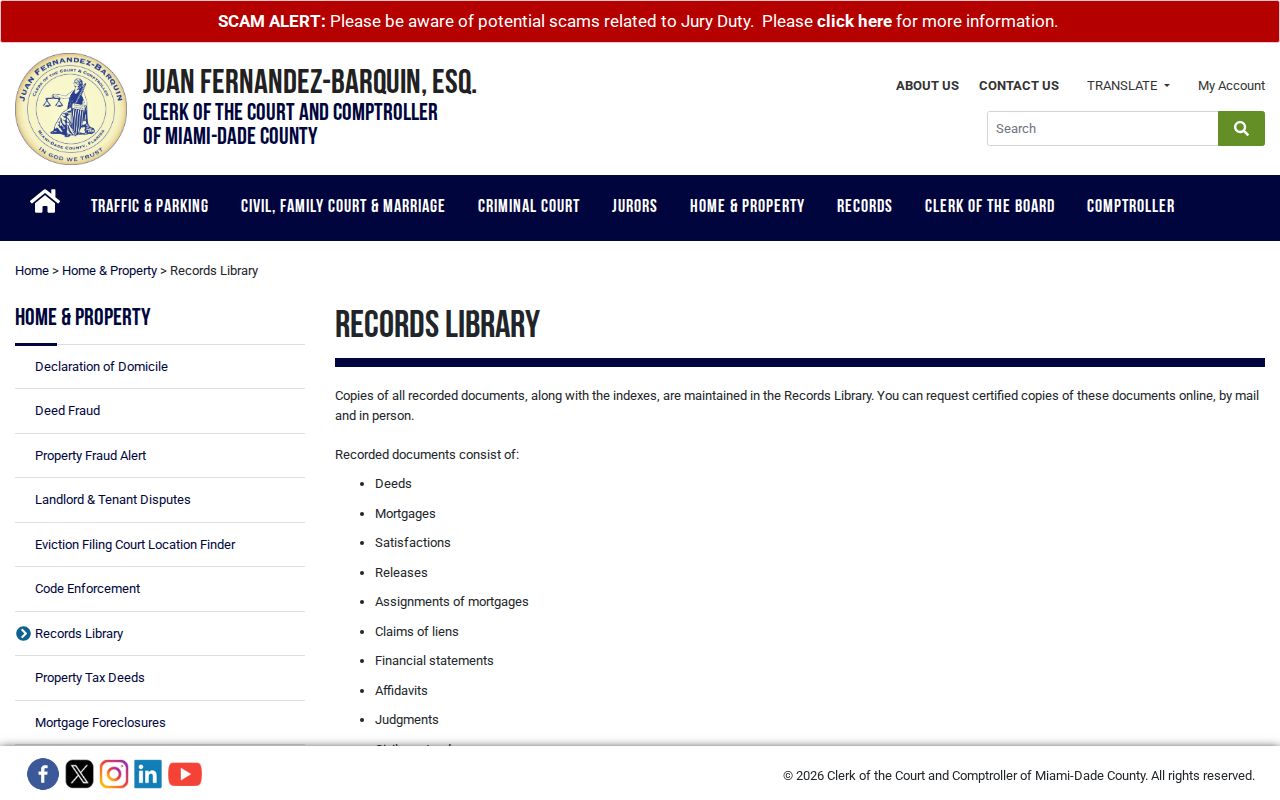
Review the official older-record options shown in the successful capture below before choosing an in-person, mail, or staff-assisted route.
Add Miami Gardens Past Residents
Ownership is only half of an address history. Selected R.L. Polk Miami directories identify a resident, spouse, work, and home address. Some editions have a reverse or criss-cross section, which arranges entries by address. Exact Miami or Carol City runs are not published as one complete list, so ask staff to verify the needed year rather than assuming annual coverage.
Pair a directory entry with the nearest census schedule. Florida state censuses for 1935 and 1945 bridge federal decades. Record each person, age or relationship where shown, and the exact road suffix. Then compare the next directory or census. A change in owner without a change in occupants may reflect an intra-family transfer. A stable owner with new names may point to renters.
- Find the address or surname in one confirmed directory year.
- Copy the full entry, including spouse, occupation, and house marker.
- Check the nearest public census for a matching household and place.
- Move to the next verified edition and note arrivals or departures.
- Confirm identity with age, spouse, work, and deed dates, not name alone.
The collection details belong in the Miami Gardens city directories resource; here, those volumes serve the backward address trail.
Search Miami Gardens Before Incorporation
Miami Gardens became a city in 2003. Older records may sit under Miami-Dade County or a community name, not under a city department. Useful terms include Andover, Bunche Park, Carol City, Scott Lake, Norland, Lake Lucerne, Opa-locka North, and Rainbow Park. Other local labels include Brentwood, Cloverleaf Estates, Kings Gardens, Myrtle Grove, and LeJeune Gardens.
This geography matters in catalogs, directory headings, newspapers, plats, and permits. Search both the modern address and historic community, then use the folio and legal description to test whether two records concern the same parcel. Postal city names and ZIP codes can cross city lines, so neither establishes jurisdiction by itself.
Missing is not destroyed. Florida Memory's WPA history rejects the tale that a Juno courthouse fire destroyed Dade records. The records had moved, and early material was reconstructed into county books.
Date Changes at Miami Gardens Homes
Permits, aerials, and parcel sketches explain why an address trail changes. The Property Appraiser offers prior aerials and building details. Miami Gardens building records can identify permit type, dates, contractor, scope, inspections, status, and sometimes an owner or applicant. Planning also handles official address assignments.
A permit does not establish previous residents. It can date an addition, demolition, or conversion that changed the parcel. If the dynamic portal fails, request city-created records by form, email, phone, or in person. Give the address, department, record type, date range, and permit number if known. Florida requesters need not state a reason.
No verified Miami Gardens street-renumbering year or dedicated Sanborn map run was found. County plats, aerials, permits, directories, and historic community names are the supported alternatives for this largely postwar-built area.
Close Miami Gardens Household Trails
When a person disappears from a directory, an obituary or probate file can explain the break. The Miami-Dade obituary index cites more than 915,000 people in newspapers from 1896 through 2008. It is an index, not the article. Retrieve the cited paper for relatives, former addresses, and community ties.
Probate dockets can connect a decedent with petitioners, heirs, a will, and property. Use the Clerk family and probate route for the case trail. Registration may be needed for images, and protected filings remain restricted. A certified copy differs from an online screen image.
Lawful personal research. Trace previous residents for family history, estate work, or a home's story. Never use an address trail to watch, harass, intimidate, or harm a living person.
Build the final chronology with a source beside every date. Owners come from parcel and deed records; occupants come from directories and censuses; death and estate events come from obituary and probate evidence. Leave uncertainty visible when the records do not prove occupancy.